“I love life and I think I’ll always want one more day. But I also know, medically speaking, that I have to die someday.”“I’m afraid of death.”“I have a terminal illness and I know the end is near. I want to leave my loved ones—and myself—a sliver of hope that maybe, someday, I could live again.”
These are the motivations shared by people around the world choosing cryopreservation. Among them is the man behind Tomorrow Bio, a Berlin-based cryonics and biotech firm with an office in the U.S.—Dr. Emil Kendziorra.
When I received a confirmation for the interview, I wasn’t sure what to expect, even though I’d already looked into the fact that the concept is more than 50 years old. It was first introduced in 1962 by Robert Ettinger, founder of the U.S.-based Cryonics Institute, in his book The Prospect of Immortality.
Then the ethical questions kicked in: if a person makes an informed choice and pays for it themselves, is it really complicated? Dr. Kendziorra answers plainly: “Of course. And we’re completely transparent: we don’t know if this will ever work, or how long it would take to bring someone back.
But what we can say with certainty is that the chance of living again is higher if you’re cryopreserved than if you’re cremated or buried.”
He adds that religious leaders are often surprisingly supportive. One believer who has since been cryopreserved told him: “If I stay on Earth longer, I can do more good for God.”
How the Process Works
Human cryopreservation—also known as biostasis or cryonics—is an advanced medical procedure that places a person into a complete biological pause after legal death. The goal is to keep them preserved until medicine is advanced enough to treat the cause of death and revive them. Cryonics offers patients a chance to benefit from technologies that don’t exist yet—and potentially live longer than is currently possible.
Once a patient becomes a client and a doctor confirms they are in their final days, Tomorrow Bio dispatches a specialized ambulance. When the patient is legally pronounced dead, the body is transferred to the vehicle and the procedure begins immediately.
The methodology draws inspiration from real-life cases of people whose hearts stopped in extreme cold but were later revived. The most famous example is Anna Bagenholm, who in 1999 spent two hours clinically dead after a skiing accident in Norway—and survived.
Extreme cold can preserve organic matter for long periods, but normal freezing creates ice crystals that damage cells. “We don’t freeze people in the traditional sense,” Kendziorra explains. “Instead, we use vitrification—the transformation of biological tissue into a glass-like state.”
In the first stage, the body is cooled below zero. Water in the tissues is gradually removed and replaced with cryoprotectant fluid—a mix of dimethyl sulfoxide (DMSO) and ethylene glycol (yes, the same components found in antifreeze).
Once the water is replaced, the body follows a precise cooling curve: quickly to –125°C, then very slowly down to –196°C.
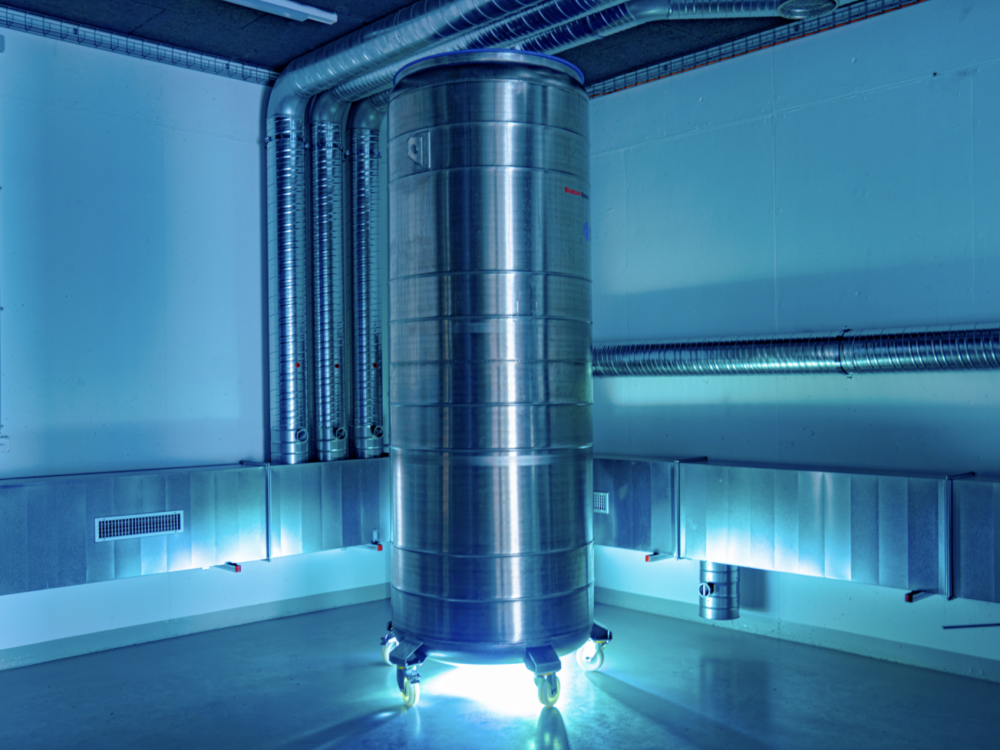
At –196°C, the patient is placed in Tomorrow Bio’s storage facility near Zurich airport, where, as Kendziorra puts it, “we wait for science to catch up with our optimism.”
The three-meter-high capsules are housed in the basement of a building that also functions as a research center. “Bodies can be stored indefinitely without electricity. Liquid nitrogen is refilled regularly by our on-site team or an automated system.”
The youngest client so far was 35 and terminally ill. In total, 20 people have been cryopreserved to date.
The Financial Model Enabling ‘Life on Pause’
Once someone becomes a client, they sign a contract confirming they will be cryopreserved at death. From that moment on, they pay a €50 monthly subscription via insurance. Upon death, €200,000 must be available.
In practice, most clients list Tomorrow Bio as the beneficiary of their life insurance policy. The company currently has 1,000 clients, with active contracts valued at roughly €200 million.
Of the €200,000, about €80,000 goes to the procedure itself. The rest flows into a Swiss foundation, invested conservatively with expected returns of 2–6% a year.
The reason is simple: no one knows how long it will take before medicine can revive a cryopreserved person. Those returns finance indefinite storage.

Kendziorra says they are also setting up a foundation in Liechtenstein where people can leave thousands—or millions of euros—as an investment in their potential future life. Since a deceased person is no longer a legal entity, the funds transfer into the foundation, which waits for the theoretical moment of revival. If it happens, the individual would inherit their own funds plus interest—“a second-life endowment,” as he describes it.
On the company side, Tomorrow Bio is backed by family offices and individual investors, enabling operations and research. Kendziorra says they are close to profitability purely from monthly subscriptions. This year alone, the firm secured €5 million in new investments.
The Personal Narrative Behind a Startup Challenging Death
“Longevity has always been my passion. It’s why I went into medicine,” Kendziorra tells me. He spent years in cancer research, launched several successful biotech startups, and used the proceeds to fund Tomorrow Bio.
His motivation is deeply personal: “I’m curious about the future. I enjoy life, and I’d rather be alive than dead.”
Working in oncology, he saw young people faced with incurable diagnoses. “You see 35-year-olds whose pain we can ease but whose death we cannot stop. I realized their only real option for hope is the future—cryopreservation. Medicine doesn’t yet have answers for all diseases, but when it eventually does, there may be hope for those preserved. You don’t get that chance if you’re cremated or buried.”
He co-founded the company with Fernando Azevedo Pinheiro in 2020, after selling two biotech startups. This, he says, is his life’s work—and he has no intention of selling it.
What People Think
I asked people what they make of the idea. Some were skeptical, calling it science fiction; others fascinated by the possibility that humans might genuinely cheat death.
Many admit that even the thought of a second chance is provoking—that it forces you to reconsider the boundaries of life, money, and hope.
Several people framed it as an investment calculation:The upside: you might live forever.The downside: you might spend €200,000 you won’t need after you’re dead anyway.A massive potential return with almost no immediate downside.
Others said it sounds like a great movie plot; some insisted it’s a scam. On LinkedIn, one commenter wrote: “Jesus offers the same thing—only free!”
What Science Says
The scientific community remains highly skeptical. No human has ever been revived after cryopreservation, and even in theory, resuscitation could result in severe brain damage.
Claims that detailed brain mapping or nanotechnology could repair damaged tissues and restore life are seen as overly ambitious—and currently unrealistic.
At the same time, cryonics is a fascinating theoretical platform. Freezing and vitrification are scientifically documented in simpler organisms and cells. Extreme cold combined with cryoprotectant solutions does prevent ice formation and structural damage.
Technically, the body can be preserved.But the gap between preservation and revival—especially of the human brain—remains a fragile bridge.
Science acknowledges the value of experimentation and preservation, but draws a line between technical feasibility and the possibility of renewed life. It’s the space where hope meets reality—and for now, that future remains uncertain.
Startups like Tomorrow Bio are trying to build a sturdier bridge between today’s life and tomorrow’s unknown. For their 1,020 clients, this is not fiction—it’s hope, strategically funded at roughly the price of a higher-end car.
After all of this, cryonics begins to feel like a mirror held up to humanity’s oldest desire, present since the earliest surviving text, The Epic of Gilgamesh: the urge to stay a little longer, to see what comes next, to believe physical death might not be the end.
In the end, maybe we can’t cheat death. But we can create room for the hope that one day, we might walk back into a life we once lost.
And sometimes, that hope alone is enough to make us feel alive again.